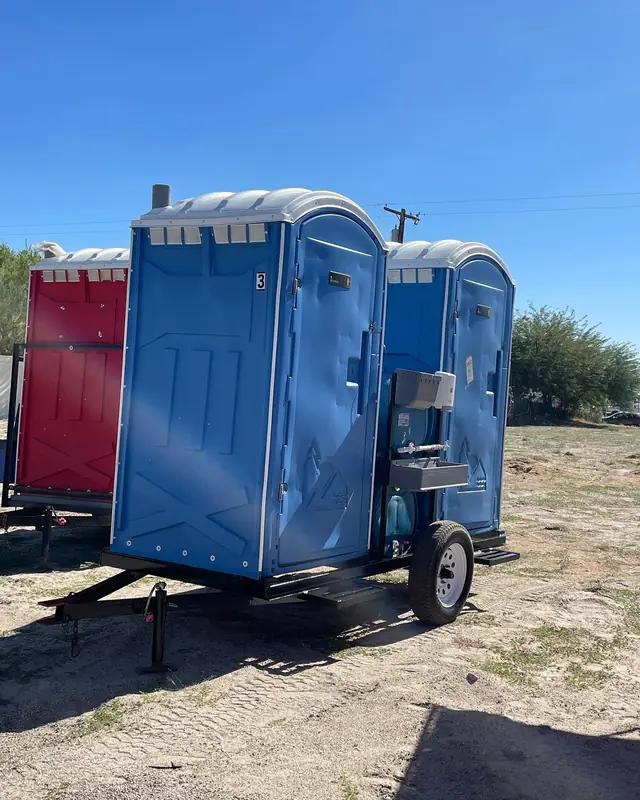
What does OSHA 1926.51 require?
OSHA 29 CFR 1926.51(c) Table D-1 requires 1 toilet for 20 or fewer employees, 1 toilet seat and 1 urinal per 40 workers for 20 or more, and 1 seat and 1 urinal per 50 workers for 200 or more. Toilets must be provided unless crews have transportation to nearby facilities.
| Employees | Minimum facilities |
|---|---|
| 20 or fewer | 1 |
| 20 or more | 1 toilet seat and 1 urinal per 40 workers |
| 200 or more | 1 toilet seat and 1 urinal per 50 workers |
Source: OSHA 1926.51 Sanitation.
Does a porta potty with a urinal count as both?
A standard porta potty with a separate urinal provides one toilet seat and one urinal in a single unit. A 40-worker crew meets the Table D-1 ratio with 1 such unit, but that unit fills in about a day, so practical counts are much higher.
What is the practical count for a weekly-serviced site?
Ivan Rental Works recommends 1 standard unit per 10 workers with weekly service. That number keeps the tank below the seat through the week. Crews of 15 per unit need 2 services a week. This recommendation sits above the legal minimum.
Worked examples
- Roofing crew of 6, 3 days: legal minimum 1; recommended 1 standard unit, no service needed.
- Framing crew of 18, 6 weeks: legal minimum 1; recommended 2 units, weekly service.
- Commercial build, 45 workers: legal minimum 2 seats + 2 urinals; recommended 5 units, weekly service, plus 1 handwashing station.
Hypothetical examples for planning.
When is handwashing required?
OSHA 1926.51(f) requires washing facilities where workers apply paints, coatings or other harmful materials, and they must be kept clean and stocked. Concrete, stucco, lead and chemical work are common triggers. A 2-sink handwashing station covers about 400 washes per fill.
Is this legal advice?
This guide explains the federal OSHA standard for planning purposes and is not legal advice. Your safety officer, contract documents, the general contractor or state rules may set a higher toilet count, so confirm the number before the job starts and before the first inspection.